Play Schools in Delhi: Is Play-Based Learning Really Better for Early Childhood Development?
posted on Sep 15, 2026
The American Academy of Pediatrics has looked into this fairly closely, and the findings are hard to argue with. Kids who learn through play tend to develop stronger problem-solving skills, more creativity, and better social-emotional development than kids stuck in purely instruction-heavy classrooms.
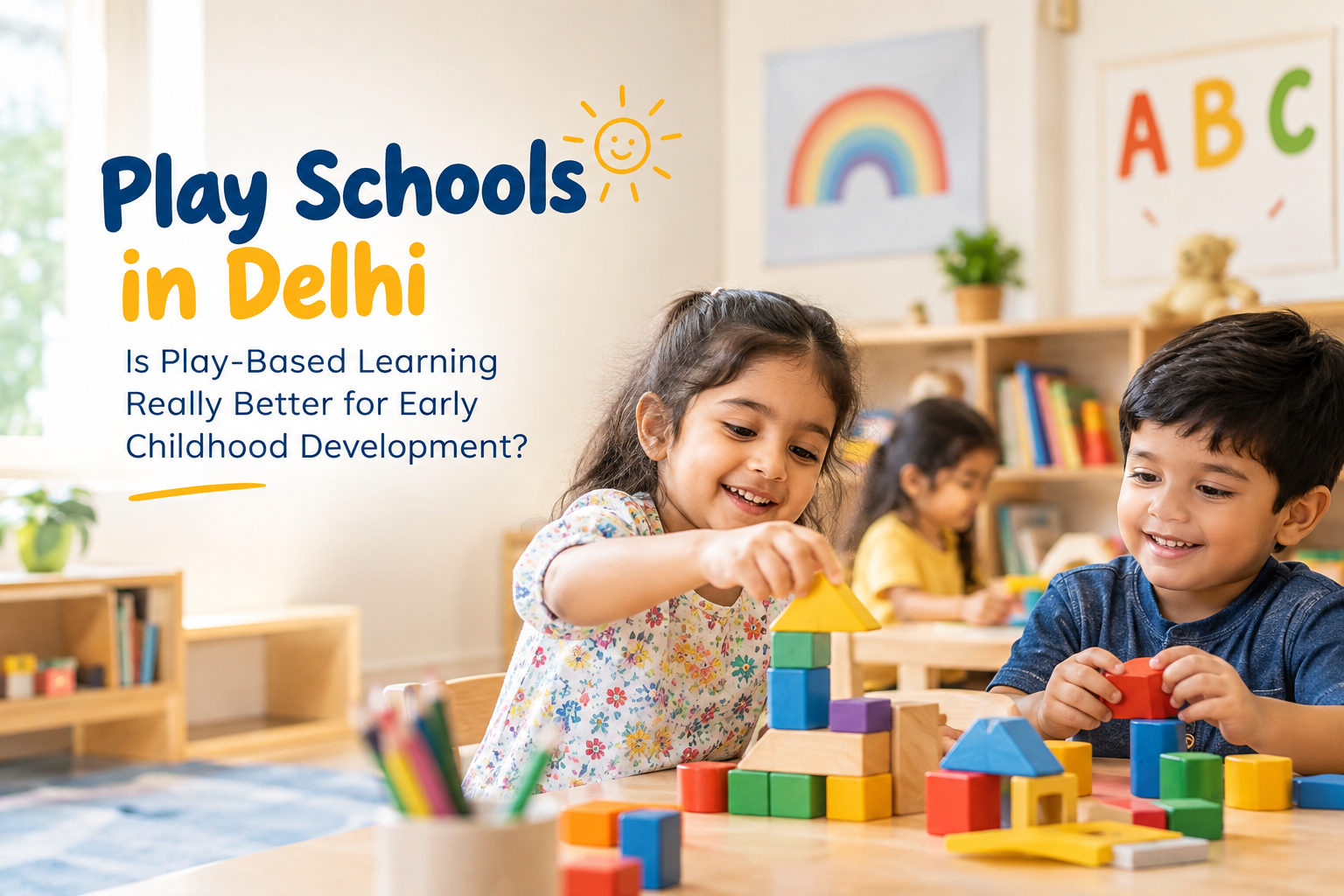
The American Academy of Pediatrics has looked into this fairly closely, and the findings are hard to argue with. Kids who learn through play tend to develop stronger problem-solving skills, more creativity, and better social-emotional development than kids stuck in purely instruction-heavy classrooms. Edutopia reported something even more specific, that play-based learning actually beats direct instruction in early maths and spatial skills, which is exactly the kind of thing most parents assume needs worksheets and repetition, not games.
So if you're currently weighing up play schools in Delhi for your child, that's worth sitting with for a second. The old assumption that play happens after the real learning is done is starting to look outdated. For a three or four year old, play is often the learning, not a break from it.
Here's what the research actually says, and what it should mean for how you pick a school.
What Play-Based Learning Looks Like When It's Done Right
This isn't just unstructured free time with a teacher standing nearby. In a classroom that actually does this well, you'll see activities that look like games but are quietly building specific skills, building blocks teaching spatial reasoning, pretend play building vocabulary, group games teaching kids how to negotiate and manage frustration. The teacher isn't stepping back here. They're steering the play somewhere useful without the child ever clocking that they're being taught anything.
Kids in these environments tend to show more openness to learning generally, better focus, and stronger collaboration with peers than kids in more rigid, instruction-first setups. That's not a small difference over a full school year.
Why the Early Years Matter So Much Here
A child's brain in these early years is essentially laying down the wiring for everything that comes after, language, motor skills, emotional regulation, basic reasoning. Pushing formal, desk-based instruction too early tends to fight against how young kids actually take in information, since at this age their attention runs almost entirely on curiosity and enjoyment, not discipline or structure.
That's a big part of why some of the better schools in Pitampura have quietly shifted their foundational years toward play-based teaching instead of early formal academics. A kid who genuinely enjoys how they're learning tends to stick with it longer, participate more, and build a healthier relationship with school itself, one that tends to stick around well past the early years.
What to Actually Look for When You're Comparing Schools
Skip the brochure language for a minute and ask more specific questions during a visit. Is there an actual, clearly laid out foundational years curriculum, or does "play-based" just get mentioned in passing? Are the teachers trained specifically in early childhood education, or are they generalists rotated in from other grades? And is there a real balance between structured play, free exploration, and some early literacy or numeracy exposure, rather than one completely crowding out the other?
You'll usually learn more from watching a class in session than from anything printed on a prospectus.
If You're Looking Specifically in Pitampura
For parents zeroing in on the best school in Pitampura Delhi, this research-backed approach shouldn't be a nice-to-have buried somewhere on the website. It should be near the top of the checklist. A strong foundational years programme sets the tone for pretty much everything that follows, academic confidence, social comfort, and an actual enthusiasm for learning that's genuinely hard to build back later if it's missed early.
Why HRM Global School Builds Around This
At HRM Global School, our foundational years programme is built directly around this understanding of how young kids actually learn. Working in partnership with Gateway Education and Rishihood University in Haryana, our curriculum runs across Foundational Years, Preparatory Years, Middle Years, and Secondary Years, each one designed specifically for that stage rather than the same template stretched across every age group.
We don't stop at structured play either. From the earliest years, we build in Interdisciplinary Learning, Civic Engagement, Cultural Awareness, Decision Making, Leadership, and Management Competency, so kids aren't just doing well academically but actually learning to think critically and adapt as they grow older. Every child who walks in brings real curiosity with them, and our job is to nurture that rather than train it out of them in favour of early rigidity.
There's an old saying that the wealth of knowledge is the ultimate wealth. No thief can steal it, no king can seize it, and unlike everything else, it only grows the more you give it away. That's really the foundation we're trying to build at HRM Global School, nurturing brilliance early enough that it actually has room to shape a future worth having.
A Few Common Questions Parents Ask
Does play-based learning work for every kind of child, or just certain personalities?
It genuinely holds up across different temperaments, mainly because it adapts to what a child is naturally curious about instead of forcing every kid through the same rigid structure.
When should schools start shifting away from play-based learning toward formal academics?
Most early childhood specialists suggest easing into it gradually. Play tends to stay useful well into the early primary years rather than disappearing the moment a child turns five or six.
How do you tell a genuinely play-based school apart from one just using the term for marketing?
Look for a real foundational years curriculum, teachers trained specifically in early childhood education, and an actual balance between guided play and some early literacy or numeracy work, not just one or the other.
If you're exploring play schools in Delhi and want to see what a genuinely research-backed foundational years programme actually looks like in practice, come visit HRM Global School and see it for yourself.