How Can Parents Compare Play Schools in Delhi?
posted on Aug 20, 2026
Choosing a play school is usually the first real decision a parent makes about their child's education, and it's also the one most parents feel least prepared for. There's no report card to look at, no board exam result, nothing concrete to measure. Just a campus tour, a brochure, and a gut feeling. That's not a great way to make a decision that shapes a child's first two or three years of learning.
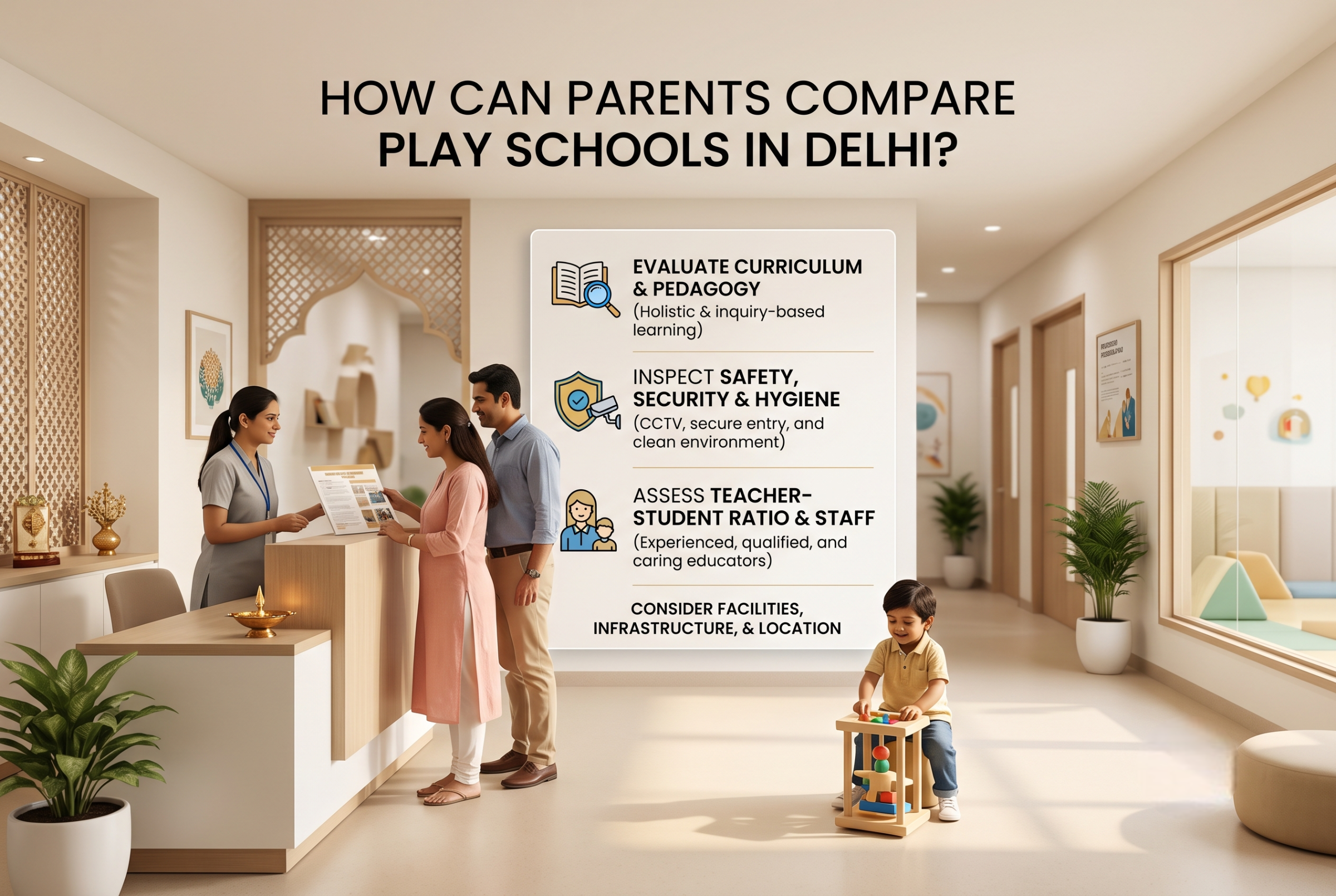
After looking closely at how this decision plays out for families across Delhi, a few things stand out. Parents who end up happy with their choice a year later almost always asked different questions than the ones most schools are prepared to answer in a standard tour. This piece walks through those questions and how to use them when comparing play schools in Delhi.
Start With What "Good" Actually Means at This Age
Before comparing any two schools, it helps to get clear on what you're actually evaluating. At the play school stage, academics in the formal sense barely exist. What matters instead is how a child spends their day, what skills are quietly being built, and whether the environment suits that child's temperament.
Three things tend to predict the best school in Pitampura Delhi experience more reliably than anything printed in a brochure:
How much unstructured play is built into the day. Play schools that pack every hour with structured activity often look impressive on a tour but leave little room for the kind of open-ended play that actually builds problem-solving and social skills. A good balance usually looks like roughly half the day being child-directed.
How teachers are trained for this specific age group. Early years teaching is a different skill from teaching older children. Ask directly whether the staff have early childhood education training, not just a general teaching degree, because the two require very different instincts.
How the school handles separation and settling in. The first few weeks at play school are as much about emotional adjustment as anything academic. Schools with a thoughtful settling-in process, gradual hours, a familiar adult present initially, tend to produce children who are genuinely comfortable, not just quiet.
Questions to Ask on a School Tour That Actually Reveal Something
Most school tours are designed to show you the nicest parts of the building. That's fine, but it won't tell you much. Here's what tends to give a clearer picture.
Ask to see a normal Tuesday, not a special event day. A lot of schools schedule tours around a festival or an activity showcase, which shows the school at its best but not at its usual. If possible, ask to observe an ordinary morning instead.
Ask what happens when a child cries or refuses to participate. Every child does this at some point. The answer tells you a lot about how patient and experienced the staff actually are, versus how they perform for a tour group.
Ask about class size and the actual adult-to-child ratio, not just the enrollment number. A class of 20 with two teachers behaves very differently from a class of 20 with one teacher and an occasional helper.
Comparing a KG School in Pitampura to Other Areas of Delhi
Pitampura has become one of the more competitive areas in North West Delhi for early education, partly because several schools here run continuously from play school through the senior years, which removes a transition point many parents worry about elsewhere.
When comparing a KG school in Pitampura against options in other parts of the city, continuity is worth weighing seriously. A child who starts at a school offering Play through Grade XII, and stays there, avoids the disruption of adjusting to an entirely new environment, new teachers, and a new teaching philosophy right around the time formal academics begin. That's not true everywhere in Delhi, where many play schools operate independently and hand children off elsewhere for Kindergarten or Grade 1.
HRM Global School in Pitampura is one example of this continuous model. It runs from Play school through Grade XII under one roof, with a student-teacher ratio that tends to stay tighter than average through the early years, something worth asking about directly at any school you're considering, since ratios often loosen as a school scales up.
What Separates the Best School in Pitampura Delhi From an Average One?
The honest answer is that it rarely comes down to infrastructure. Two schools with similar buildings, similar fee structures, and similar brochures can produce very different experiences for a child, and the difference is almost always in the people, not the property.
Look for schools with low staff turnover. A play school where teachers have been there for several years usually means the environment is stable enough for children to build real relationships with the adults around them, which matters enormously at this age. High turnover, even in an otherwise well-resourced school, tends to unsettle young children more than parents expect.
Also worth checking is how the school communicates with parents day to day. A daily update, a note about what a child ate or how they napped, a photo now and then, might seem like a small thing, but it usually reflects a broader culture of attentiveness that carries into the classroom itself.
Frequently Asked Questions
What age should a child start play school in Delhi?
Most play schools in Delhi accept children starting around age 2 to 3, though the exact cutoff varies by school and is usually tied to a specific date, often March 31 of the admission year. It's worth confirming the exact age requirement directly with each school you're considering.
Is it better to choose a school that continues through Kindergarten and beyond?
For many families, yes. A school offering continuity from play school through Kindergarten and further, like HRM Global School in Pitampura does through to Grade XII, removes a transition point that can otherwise disrupt a child's early academic and emotional development.
How important is student-teacher ratio at the play school stage?
Young children need frequent individual attention, for comfort, safety, and early skill building. A ratio significantly above what a school advertises as its average is worth asking about directly, since averages can hide larger class sizes in specific batches.
Should I choose a school based on facilities or teaching approach?
Teaching approach matters more at this age. Facilities are easy to photograph and market, but the actual daily experience, how teachers respond to children, how much unstructured play is allowed, how settling-in is handled, has a far bigger impact on a young child's development.
Making the Decision
There's no single right answer here, and any parent who tells you otherwise is probably describing their own experience rather than a universal rule. What's worth doing is visiting more than one school, asking the uncomfortable questions rather than the easy ones, and paying attention to how a school handles an ordinary, imperfect moment rather than a polished one. Schools like HRM Global School in Pitampura, which combine early years continuity with a relatively low student-teacher ratio, are worth including in that comparison, but the final decision should come from what you actually see and feel on a real visit, not from any list, including this one.