Are Smart Classrooms Enough? What Parents Should Expect From Top Schools in Pitampura
posted on Sep 23, 2026
There's a particular moment almost every parent in Pitampura goes through. You walk into a school for an admission enquiry, someone from the front office proudly walks you past a room with a giant interactive screen mounted on the wall, and you nod approvingly because, well, it looks impressive
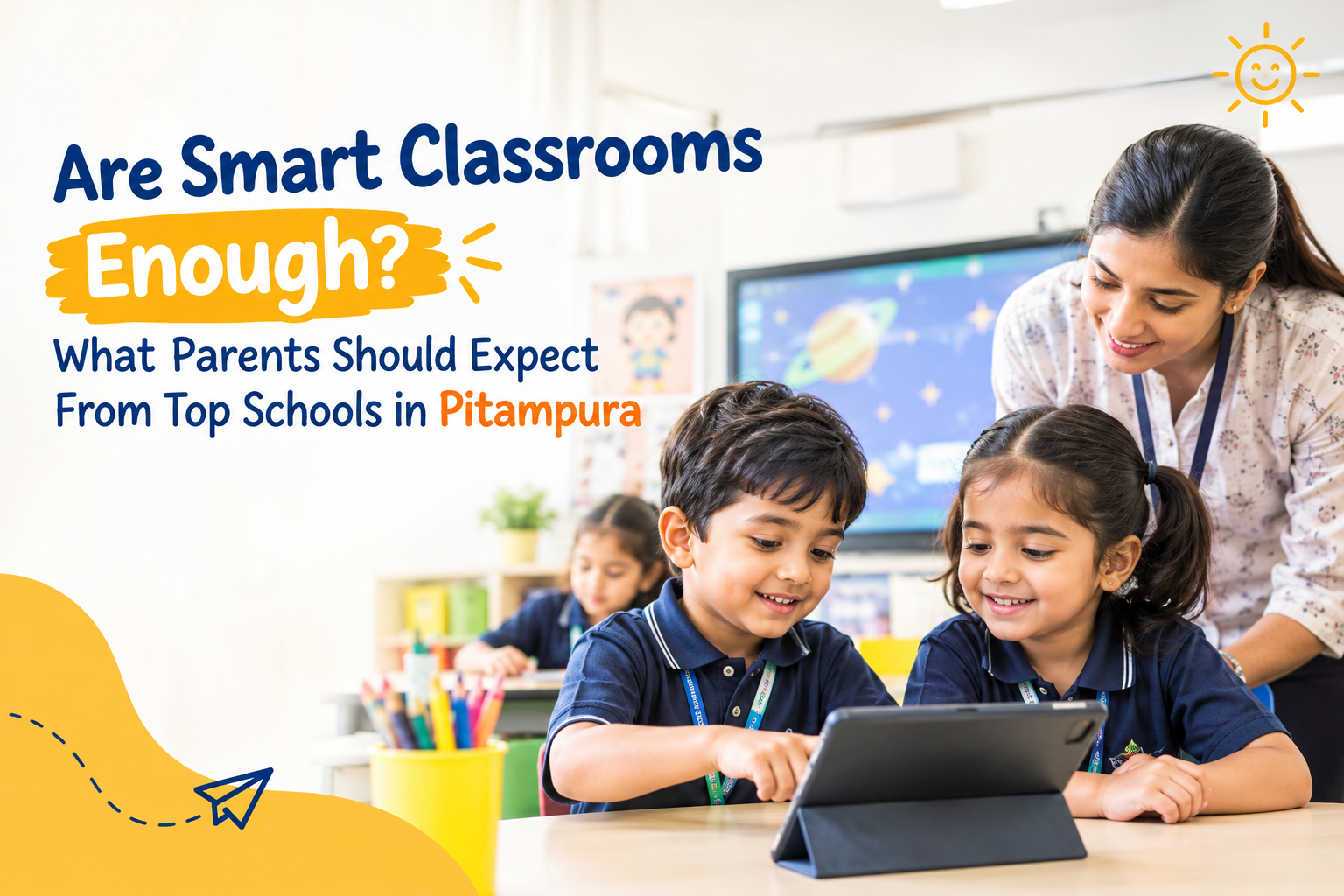
Then you get home and your spouse asks, "So how was it?" and you find yourself saying "they have smart classrooms" as if that answers the actual question of whether this is the right school for your child.
We get it. Smart classrooms have become the shorthand for "modern school" in almost every conversation parents have these days. But here's an honest question worth sitting with for a minute: is a screen on the wall really enough to decide where your three, four, or fourteen-year-old spends the next decade of their life? At HRM Global School, our answer is a firm no, and we think it's worth explaining why, especially for parents currently going through the admission season and trying to make sense of which schools genuinely deserve to be called the top schools in Pitampura.
What a Smart Classroom Actually Does, and What It Doesn't
Let's give credit where it's due. A well-used smart classroom can genuinely change how a lesson lands. A teacher explaining the water cycle with an animated diagram is going to hold a seven-year-old's attention far better than chalk dust and a static drawing. Complex topics in physics or geography become easier to visualize. Children who are visual learners, and there are plenty of them, finally get material presented in a way that actually makes sense to them.
But here's what a smart classroom cannot do. It cannot make a bored teacher engaging. It cannot make a rigid, outdated curriculum suddenly relevant. It cannot replace the moment when a child raises their hand with a slightly odd, slightly brilliant question and a teacher takes the time to actually explore it instead of rushing back to the syllabus. Technology is a tool, not a teaching philosophy. A school that leans entirely on the phrase "we have smart classrooms" in its brochure and stops the conversation there is, frankly, telling you more about what it's trying to sell than what it's actually offering your child.
So the real question parents should be asking isn't "do you have smart classrooms." Almost everyone does now. The better question is, "how do your teachers actually use them, and what happens in the fifteen other things that make up a school day?"
The Curriculum Conversation Nobody Has Properly
Most parents ask about CBSE versus other boards and then move on. Fair enough, that's an important first filter. But within any board, there's enormous variation in how a curriculum is actually delivered. Does the school encourage project-based learning, where children research and build something themselves, or is it still mostly textbook and memorization? Are children given room to ask questions that go slightly off-script, or is the classroom paced so tightly that curiosity gets treated as an interruption?
A genuinely good school treats the curriculum as a floor, not a ceiling. It uses the syllabus as the minimum requirement and then builds actual thinking, discussion, and application on top of it. When you're touring a school, ask to see a sample lesson plan if you can, or ask a teacher directly how they handle a class where half the children have already grasped a concept and half haven't. Their answer will tell you far more than any smart board demo.
Play Schools and Early Years, Where the Real Foundation Gets Built
Here's something a lot of parents underestimate until they're actually going through it. The early years, the play school and pre-primary stage, matter enormously more than most people realize when they're focused on smart classrooms and board results for older grades. If you're currently looking into play schools admission in Pitampura, our honest advice is to slow down and look past the colourful walls and the cute uniforms.
What actually matters at this stage is whether the environment is genuinely nurturing. Are the caregivers trained in early childhood education, or are they just enthusiastic and kind, which helps but isn't the same thing? Is there a proper balance between structured activity and free play, because young children need both to develop social skills and independent thinking? Is the transition from play school into formal schooling handled smoothly, with continuity in approach rather than a jarring shift from all-play to all-academics overnight?
Among play schools in Delhi, the ones that stand out are rarely the ones with the most elaborate infrastructure. They're the ones where a three-year-old walks in crying on day one and, within a few weeks, is genuinely excited to go back the next morning. That shift doesn't come from a smart board. It comes from teachers who understand child psychology and a school culture that treats early childhood as a specialised skill, not a stepping stone job.
The People in the Building Matter More Than the Building Itself
We've said this before and we'll keep saying it because it's the single most overlooked factor in how parents choose schools. Infrastructure is important, but it's teachers who make or break a child's experience. A smart classroom in the hands of a teacher who genuinely enjoys working with children, who notices when a usually chatty student has gone quiet, who takes the time to explain a concept a third time without making a child feel slow, is worth far more than the fanciest equipment handled by someone just going through the motions.
When you're evaluating schools, try to get a sense of teacher tenure and morale. Ask how often teachers attend training, how the school handles a teacher's concern about a struggling student, and if possible, try to observe an actual class rather than just a rehearsed demo lesson. Parents who've been through the admission process a few times will tell you that the schools that feel warm and alive during an actual weekday visit are usually the ones worth prioritising over the ones that only impress during a scheduled tour.
Beyond Academics, What Else Should Be on Your Checklist
A well-rounded school experience covers a lot more ground than most brochures suggest. Here's what we think parents should genuinely be checking for:
Emotional support systems, including access to a school counsellor who children can actually approach without feeling like it's a big, scary step. Sports and physical activity that go beyond a once-a-week period, because movement and physical confidence shape a child's overall wellbeing far more than people give it credit for. Art, music, and creative spaces where children who don't necessarily shine in exams still get to feel genuinely good at something. Safety measures that are visible and verifiable, not just mentioned in passing during a sales pitch. And communication, meaning how easily and honestly the school keeps parents informed, not just about marks but about how their child is actually doing day to day.
None of these show up in a five-minute campus tour focused on smart classrooms. They show up over months, in the small details of how a school actually runs.
What We're Trying to Build at HRM Global School
We won't pretend we have all of this figured out perfectly, because no school does. But at HRM Global School, we've tried hard to make sure our smart classrooms are a tool our teachers actually use well, not a headline we put on a hoarding and forget about. Our early years programme is built by people who specialise in how young children actually learn and settle in, which matters enormously for parents exploring play schools admission in Pitampura for the first time. And we've tried to build a culture where teachers stay, where children feel noticed, and where the things that don't show up in a brochure, like a child's confidence or their willingness to ask a question in class, are taken just as seriously as exam results.
If you're currently comparing schools and trying to figure out who genuinely deserves to be considered among the top schools in Pitampura, our honest suggestion is this: don't stop at the smart classroom. Ask about the teachers. Ask about the early years programme if you have a younger child. Visit on a regular weekday, not just during an official tour. And trust what you feel when you watch how the staff actually interacts with the children who are already there.
We'd genuinely love for you to come see this for yourself at HRM Global School. Come visit, ask us the difficult questions, sit in on a class if you'd like, and decide for yourself whether we're the kind of school your child deserves to grow up in.
FAQs
1. Are smart classrooms enough when choosing a school?
No. Smart classrooms are useful, but parents should also consider teaching quality, curriculum, safety, sports, co-curricular activities, and emotional support.
2. What should parents look for in a school in Pitampura?
Parents should look at teacher quality, learning methods, infrastructure, safety, student support, activities, and how the school communicates with families.
3. What should parents consider when choosing a play school in Pitampura?
Look for trained early-years educators, a nurturing environment, opportunities for play and exploration, and a smooth transition into formal schooling.
4. How important are teachers in a modern school?
Teachers play a central role in a child's learning experience. Their training, approach, engagement, and ability to understand individual students matter greatly.
5. What should a well-rounded school offer beyond academics?
A good school should provide opportunities for sports, arts, music, creative learning, counselling, and other activities that support a child's overall development.